Guy Foster and I had two excellent dives yesterday with "Sanctuary" a dive boat that only takes up to six divers at a time. We first cruised down to Carmel Bay and dived on a site on the Pinnacles called "Outer Inner" because it is the outer edge of the inner Pinnacles. Our second dive was at a site back inside Monterey Bay about 1/3 of a mile off Coral Street in Pacific Grove. On both dives we had excellent visibility of at least 35 ft, water temp was 51 degrees.
I was very pleased to see that Bull Kelp is making a strong comeback though there is still little of any of the usual Giant Kelp that has been missing since the sea star plague of 2013 led to an explosion in sea urchins. We were buzzed by a sea lion a couple times on this dive, I managed to focus and shoot it once...Still too many sea urchins! Below are some photos from our "Outer Inner" Pinnacles dive, for more, please go to:
https://photos.app.goo.gl/p5B8SbWlTOgoSogX2
Guy "splashes" off Sanctuary to start our dive on the "Outer Inner" Pinnacles.
It's a lot more pleasant to have a scattering of Yellow Purple-striped Sea Nettles in clear water!
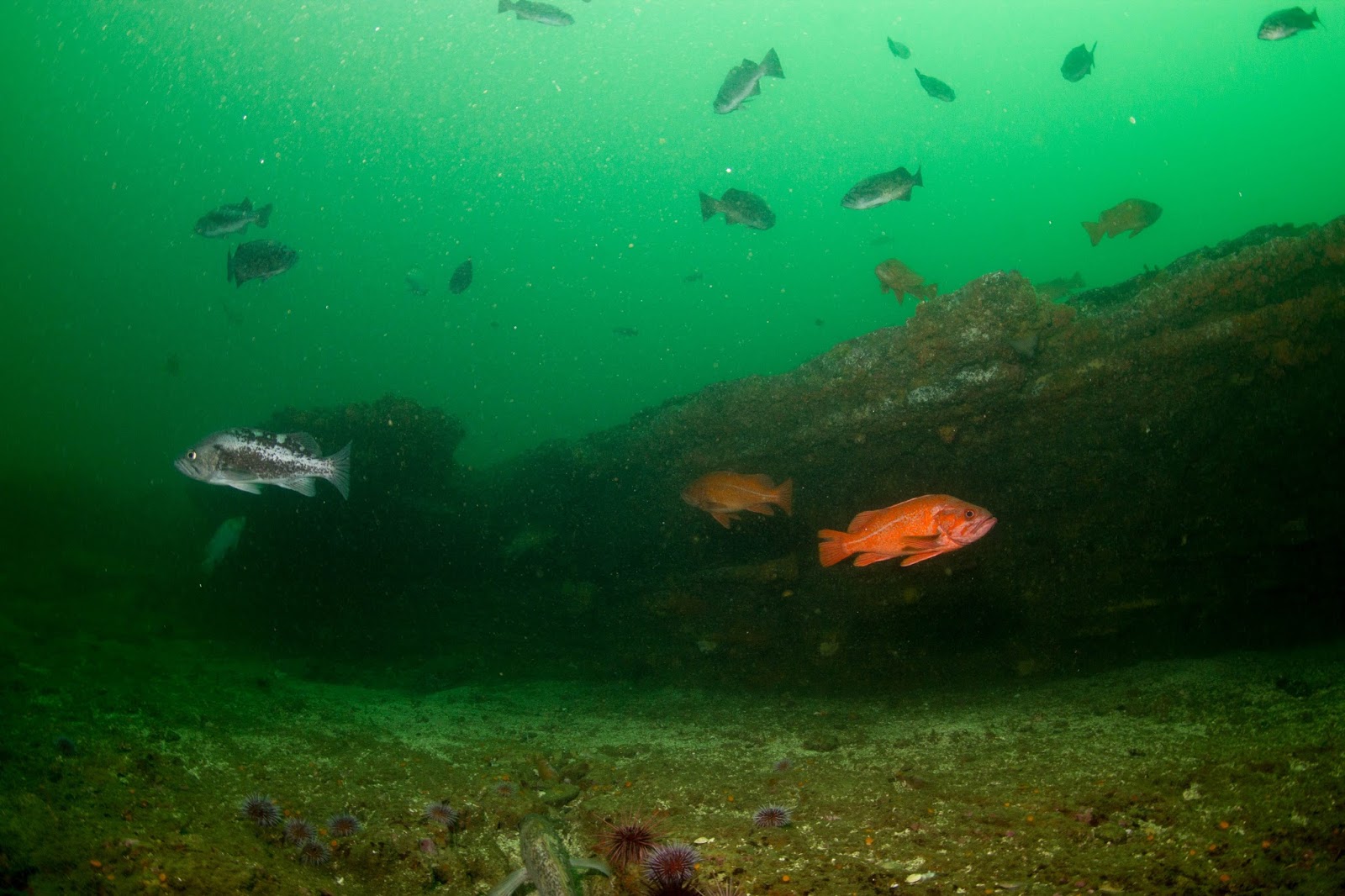
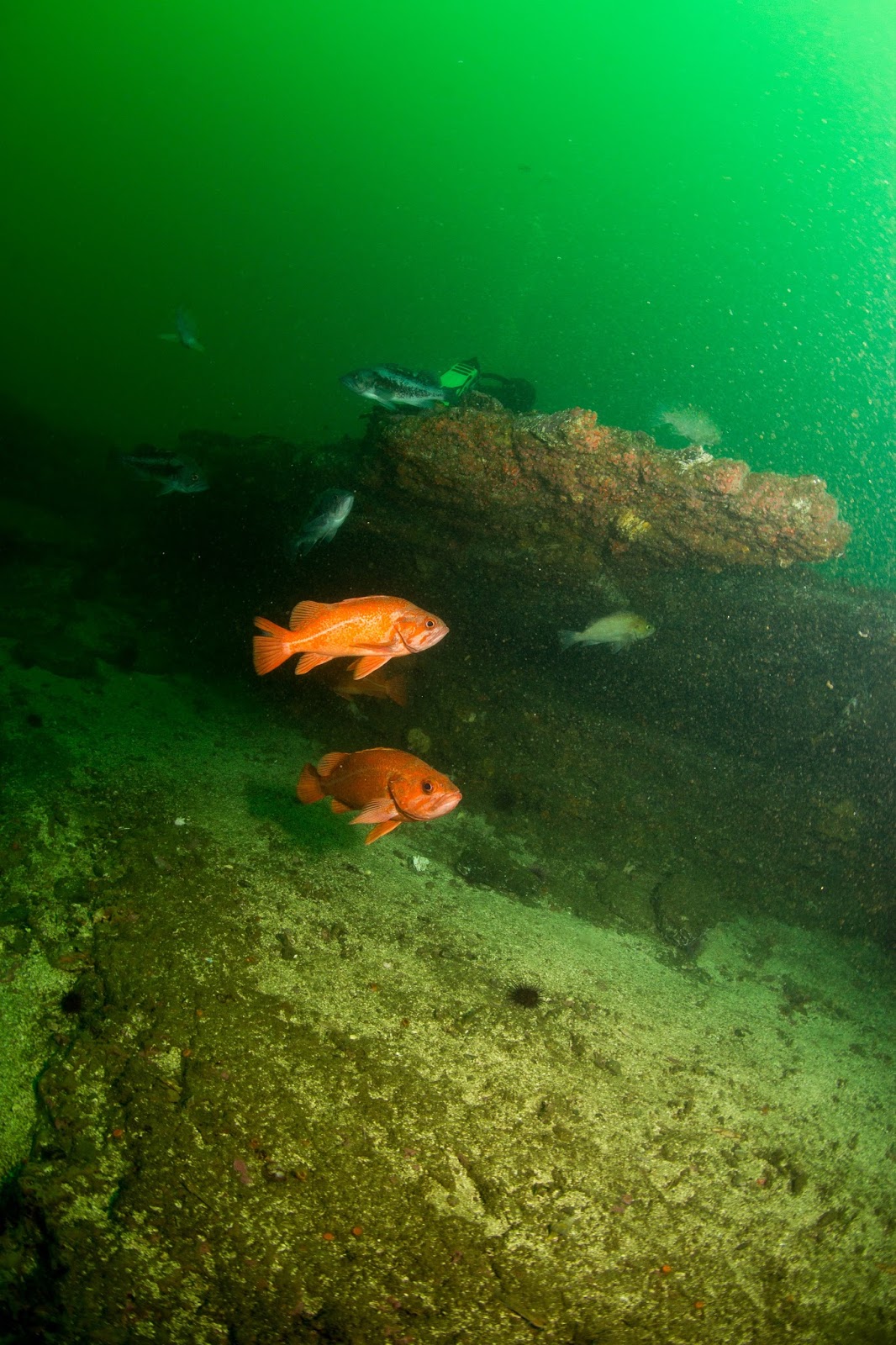
Predictably, if a Vermilion Rockfish presents itself, I will of course shoot it. Notice the beautiful water color and the amount of light I'm getting from the SE on this morning dive in October,even 65 ft down. The sun is getting lower and very noticeably south. There was a very long period swell running, actually two, from NW and SW, so when in one of the canyons found throughout the Pinnacles (they run mostly East and West) the energy gets channeled and we'd get shove back and forth 6 to even 10 feet back and forth with each swell. Have to time your photos!
Guy shooting on the wall of one of the canyons, during a pause in the swell displacement, which is why I could shoot him, too.
A big, healthy spiny sea star, hopefully it will help eat up sea urchins of which there are still far too many. In normal times you only find sea urchins in crevices. Hopefully the sea otters will make progress, eating the larger ones, too. Sadly, still no sign of any Sunflower Stars, haven't seen these aggressive predator sea stars in four years.
Still way too many sea urchins, some of them are now sizeable. They are keeping us from having our normally huge kelp forests, though we are past the low point at last.
A large Sea Lemon Nudibranch (six inches) with purple sea urchins and Strawberry Anemones.
A sparse kelp bed plus clear skies and clear water equals outstanding light, even down 60 ft.
Up the anchor chain to our safety stop, entertained by passing Purple Striped Sea Nettles
Mike (Sanctuary's owner/captain) wisely took us back to Monterey Bay for our second dive in the face of rising (and forecasted) winds. We tried to go dive the Shale Reef right off Del Monte Beach but the water was brownish green and full of sea nettles, also a sailing regatta was just about to start and would cross our dive site so on (fortunately, it turned out!) to Plan B. Our second dive was at a site called "Aumentos" just east of Point Pinos off Chase Reef, offshore from Coral Street beach. At this site you are located where there is lots of boat traffic so it is best if you can find your way back to the anchor and surface at the boat. We enjoyed great visibility so keeping track of the anchor was quite easy. The site is a series of pinnacles from five to 15 ft high. Lots of white Metridium sea anemones, lots of strawberry anemones, a really cool site. Below are some photos from this dive, for more please go to:
https://photos.app.goo.gl/yuQvE5N1dWS8uWa72
I took this shot as I followed Guy down to Aumentos (depths of 55-85 ft) great visibility, good light!
Guy cruising Aumentos.
We had beautiful visibility and great light.
Metridium Anemone aka Plumrose Anemone, surrounded by Strawberry Anemones.
Yes, I would say Aumentos has a plethora of Metridium Anemones!
Guy taking closeups, look t the light and visibility! Great rock structure at Aumentos.
Copper Rockfish
Guy with a Lingcod on his perch.
Lingcod closeup
Guy gets a Lingcod shot.
Up the anchor chain for our safety stop with Dan and Kendra, the two other divers on this trip with us. You can see the shadow of Sanctuary (ha, literally and figuratively!) above us. Aumentos has lots of boat traffic so you really want to come up the anchor chain to your boat.
Monday, October 9, 2017
Saturday, September 30, 2017
Excellent Dive at Mono-lobo, Carmel Bay September 28,2017
Greg Hoberg and I had an excellent dive on Mono-lobo last Thursday. We had very calm conditions so we were able to speed down to Cypress Point at the north end of Carmel Bay. At Cypress Point we spotted a very large pod of Risso's dolphins. We proceeded to the Pinnacles and were pleased to see the Bull Kelp bed there continues to recover though there still is a notable dearth Giant Kelp. The surface visibility was still pretty limited so we went on towards Mono-lobo, on the way we saw two or three Humpbacks. We found the surface to be noticeably clearer at Mono-lobo so anchored at the outer edge of the rapidly recovering Giant Kelp and Bull Kelp bed. The overall bed is now about 2/3rds of normal size. When we descended we found a murky, plankton rich layer down about 10 ft extending down to about 35 ft, then, fortunately it cleared up again, we had 20 to 25 ft of visibility at the bottom (65 ft). We were next to a nice wall and spent our entire dive going back and forth and up and down an area about 60 ft long by 25 ft high. I was pleased to see that the remaining urchins were tucked back in crevices which is normally the case when we aren't under urchin plague conditions. Hence the recovering kelp. Bottom temp was 52 degrees but we still got cold due to how little swimming we did. We had lots of good subjects on the rich edge of the kelp bed including a really cool red Kelpfish (aka Kelp Blenny) about four inches long, a beautiful Horned Nudibranch (aka Opalescent Nudibranch) Hemissenda Crassicornis, and a very patient Cabezon along with the usual rockfish. When we surfaced we found that the wind and sea chop were increasing rapidly so we headed back to Monterey Bay (along the way it was good to see that Bull Kelp is finally coming back off Point Joe but no sign of Giant Kelp there yet). We decided the water was too brown and rather than hope that it opened up down below we called it a day. As we passed Hopkin's Marine Lab a Humpback made a very impressive tail throw quite near us, we had no idea they could put so much of the back of their body up out of the water!
Below are some pictures from the dive, for more please go to:
https://photos.app.goo.gl/rvmo482jQb19RVfy1
A Blackeyed Goby perched on a rock above an Orange Sea Cucumber and below a White spotted Rose anemone.
Dense invertebrate life, including a sea urchin in a crevice where it belongs during daylight, with a juvenile rockfish.
Here are several pictures I took of a pretty red Kelpfish (aka Kelp Blenny), could be a spotted kelpfish or a crevice kelpfish. First time I've seen and photoed a red one, I believe. It's about four inches long. I'm quite pleased with the pictures since I was shooting with my wide angle Tokina fisheye 10-17 mm lens. f18, ISO 200, TTL on my strobe, 1/125 sec.
Juvenile Rockfish with sea anemone tentacles
Juvenile Rockfish with Strawberry Anemones, black sea urchin, and orange cup corals.
Gopher Rockfish with White Spotted Rose Anemone and pink Hydrocoral.
Horned Nudibranch aka Opalescent Nudibranch, Hemissenda Crassicornis, about four inches long.
Greg getting Cabezon closeups!
Below are some pictures from the dive, for more please go to:
https://photos.app.goo.gl/rvmo482jQb19RVfy1
A Blackeyed Goby perched on a rock above an Orange Sea Cucumber and below a White spotted Rose anemone.
Dense invertebrate life, including a sea urchin in a crevice where it belongs during daylight, with a juvenile rockfish.
Here are several pictures I took of a pretty red Kelpfish (aka Kelp Blenny), could be a spotted kelpfish or a crevice kelpfish. First time I've seen and photoed a red one, I believe. It's about four inches long. I'm quite pleased with the pictures since I was shooting with my wide angle Tokina fisheye 10-17 mm lens. f18, ISO 200, TTL on my strobe, 1/125 sec.
Juvenile Rockfish with sea anemone tentacles
Juvenile Rockfish with Strawberry Anemones, black sea urchin, and orange cup corals.
Gopher Rockfish with White Spotted Rose Anemone and pink Hydrocoral.
Horned Nudibranch aka Opalescent Nudibranch, Hemissenda Crassicornis, about four inches long.
Greg getting pictures of the nudibranch. Note the green water, hopefully we'll get more blue clear water soon as the days keep getting shorter and the nights longer to reduce the plankton bloom.
A well camouflaged Coralline Sculpin, about four inches long, I only spotted him because he moved! Again, not bad, given that I'm shooting with my wide angle lens.
Diving this coming Saturday, Oct 7 with Guy Foster on the Sanctuary.
Monday, September 25, 2017
Good dives on Erik's Pinnacle and the Shale Reef with Sanctuary September 23, 2017
I had two good dives with the Sanctuary dive boat out of Monterey last Saturday. When the morning started winds were calm and so were the seas with a average swell running, but shrinking. However, though early conditions were good the marine forecast was for small craft warnings in the afternoon with west winds of 15 to 25 knots. I was hoping since it was calm at departure time that Sanctuary would take us to Carmel Bay for our first dive but the captain, Mitch, decided to avoid a likely rough return by staying inside Monterey Bay. While leaving the harbor with six paying divers (one, visiting from the Netherlands paid Paula, our dive master, for two guided tour dives), the water was jam packed with millions of Yellow purple striped sea nettle jellyfish. The most I've ever seen by a long shot. There must have been an average of 20 sea nettles per cubic foot of water! Fortunately, when we got to our dive site, Erik's Pinnacle, there were only the normal seasonal scattering of sea nettles on the incoming tide. Visibility at the surface, which was very green to brown with algae/plankton was only 6 to 8 ft but down about 15 to 20 feet the visibility opened up to 25 ft or so. Water temp at the bottom was a normal seasonal 51 degrees. Below are some photos from this dive, to see more, please go to: https://photos.app.goo.gl/NJwS5vBlyYoXJVSH2
Visibility at the bottom, 60 ft, at Erik's Pinnacle was a decent 25 ft.
A tube anemone with a couple of (the still too many) sea urchins still limiting kelp bed growth.
A large Masking Crab
A startled Decorator Crab
Copper Rockfish
A Fish Eating Anemone on one of the large rocks scattered near Erik's Pinnacle.
Whitespotted Rose Anemone
It's hard to make out but here is a large mussel on Erik's Pinnacle. You rarely if ever saw these at diving depths before the sea star wasting disease decimated the populations of Ochre and Spiny Sea Stars.
A burrowing clam, I think a Wart-Neck Piddock
Visibility at the bottom, 60 ft, at Erik's Pinnacle was a decent 25 ft.
A tube anemone with a couple of (the still too many) sea urchins still limiting kelp bed growth.
A large Masking Crab
A startled Decorator Crab
Copper Rockfish
A Fish Eating Anemone on one of the large rocks scattered near Erik's Pinnacle.
Whitespotted Rose Anemone
Looking up Erik's Pinnacle, the water got greener with more algae and plankton as you approached the top of Erik's Pinnacle at about 20 ft (good place for a safety stop with some Giant Kelp re-established on it).
I spotted a Lingcod on my way up the pinnacle.
Morgan, one of the other divers on the trip, getting some shots on the pinnacle
I spotted a Snubnose Sculpin in amongst some large Acorn Barnacles. See him?
Not bad for shooting with my wide angle lens...
I shot some Yellow Purple Striped Sea Nettles while on my safety stop.
Our second dive site, which we went to after dropping off a couple very sea sick divers back at Monterey Harbor, was another favorite for me, the Shale Reef, about 300 yards or so off Del Monte Beach (I've done this once from shore but won't do it from shore again until the next time I'm 19...Good judgement comes from experience, experience comes from bad judgment...). Again, the water was murky brownish green with algae and plankton bloom due to consecutive sunny days without fog but, fortunately, it opened up to 20 to 25 ft of visibility once you got down about 20 ft. Below are some pictures from this dive, for more please go to:
One of the first things I spotted when I swam from the anchor over to the shale reef was this desperate young (only three inches across) abalone which had been force to leave its protective crevasse in order to rome the rocks trying to find enough plant life to eat because of hordes of ravenous sea urchins. It was surrounded by sea urchins and really struggling. I intervened by removing the sea urchins.
If you look closely you can see some Coonstripe Shrimp.
A Bluebanded Ronquil, about five inches long, only the second or third time I've photoed this fish.
The Shale Reef is on a different geologic plate than the rest of the Monterey peninsula. The shale reef is sandstone or limestone instead of the granite found on all our other local dive sites. The shale ledges remind me of the limestone ledges I dived when growing up in Dunedin, Florida.
I can never resist taking pictures of Vermilion Rockfish.
As I swam along the reef I spotted a Cabezon. See it?
Ok, I'm proud of this despite the backscatter from having my strobe poorly positioned. A Vermilion Rockfish and a Cabezon in the same photo.
Sand-Rose Anemone
Another burrowing clam, a Scaleside Piddock
Hope to do some more dives on the Shale Reef, love it.
Subscribe to:
Posts (Atom)